Wrap-Up
The Puzzle War Concludes!
Paradox Puzzlehunt has ended. Congratulations to the 109 teams that were able to help Princesses Rhyme and Reason reconcile their differences and restore peace to the Kingdom of Wisdom. And thank you to all 589 teams who fought honorably for their faction! In this wrap-up, we’ll be reviewing the process of creating and running Paradox Puzzlehunt and sharing our funniest and most helpful tidbits of behind-the-scenes knowledge. We will do our best to mark spoilers for the metapuzzles, but this wrapup will include spoilers for feeder puzzles and pre-meta story.
Before you read any further, we highly encourage you to fill out our feedback form! Anything from a quick note on a single puzzle to an in-depth hunt diary is helpful and appreciated.
If you would like a memento of your time in the Lands Beyond, there is a limited time left to order stickers! Both Rhyme and Reason sticker packs are available, and each one includes a special bonus sticker celebrating the Princesses’ reconciliation. The shop will only be open until Sunday, August 30th at 11pm ET, so order now!


We expect stickers to be shipped during the first week of September.
Now, to answer your burning questions…
Who won the puzzle war!?
What an absurd question! As the Princesses realized, division and conflict have no place in puzzling. Every team that tried their best and had fun is a winner!
Okay sure, whatever. Which side got more points?
By the end of the hunt, Princess Rhyme’s faction collected 1579 points, narrowly beating out Princess Reason’s 1559 points! Fittingly, our first place team Cross Words of Warning was representing Princess Rhyme — though Reason teams swept 7 of the of the remaining top 10 places!
The even more coveted "Best ParaSocial Content Award" goes to Eggplant Parms, representing team Reason. Their posts and memes added immensely to the hunt atmosphere and never failed to make us laugh.
Theme & Story
Mostly written by BenThough we enjoyed the quirky theming of the first Paradox Puzzlehunt, we wanted this iteration to have a stronger commitment to theme and story. We quickly settled on the Phantom Tollbooth as the central theme — not only was it a childhood favorite of multiple members of the team (see Ethan’s 5th-grade book report below!), it seemed like the perfect basis for a puzzlehunt. Its approach to storytelling often centers on taking absurd puns or facts literally, an ethos that’s present in many of our favorite puzzle experiences.

(It seemed like other hunt runners agreed it was a good fit, since within a year of us committing to that theme, the Phantom Tollbooth was featured in a late round of Mystery Hunt! We were very worried about this back when we thought we’d be releasing the hunt in 2022-23).
The broad story arc of the hunt also developed quickly. Rhyme and Reason supporting different kinds of puzzles made for a natural conflict, and the natural conclusion was for them to make amends. We also liked that this story arc used only a few characters and locations from the book, allowing it to be easily grasped by teams with varying levels of Phantom Tollbooth knowledge.
Once we knew that the hunt would come down to a climactic battle between Rhyme and Reason, we started thinking of ways to make that story moment feel big. We’re not a huge team so doing anything with insane production value wouldn’t be possible and, although we’re proud of our writing chops, as Ethan often pointed out: "people don’t read during hunts." So we picked out some priorities that we could accomplish.
Rhyme and Reason
First and most important was defining the princesses. We wanted them to feel cool enough to pledge undying loyalty to, but real enough that you could imagine them being on your puzzle team. For a dichotomy like this it’s easy to go with cliche left brain / right brain stereotypes so we did our best to flesh them out with other details (e.g. Reason being a horse girl, Rhyme being a rapper).
We decided that each princess’s "splash art" would be the main art asset we’d budget for, so that solvers could get an idea of who Rhyme and Reason were at a glance. For those who wanted more depth, we wrote their interviews with the Times and their ParaSocial profile. With these additional details, we hoped that all solvers and all puzzle types would feel represented by one of the two sisters.
Creating a Civil War
How could we make the hunt’s story bigger than the hunt itself? By starting the story before the hunt even kicked off and involving the entire puzzlehunt community! We wanted to stoke discussion, debate, and tribalism between the followers of Rhyme and Reason to get teams engaging with our story while they weren’t in the "finish the hunt as fast as possible" mindset.
Big media properties have done this sort of viral marketing (#teamedward / #teamjacob, Team Cap or Team Iron Man), but it was something we’d not seen in puzzlehunts before and we wanted to explore that frontier. It was really fun to hear our testsolvers call things "Rhyme-coded" and see people playing up the kayfabe on ParaSocial!

Despite how carefully we worked on balancing the two sides, we were worried it was going to end up as a blowout. The degree to which it stayed close astonished us and made the points system feel very competitive!
Initially, we had intended for the community "civil war" to spread naturally to existing online puzzle circles. Separately, we were planning to create Rhyme and Reason accounts on external social media platforms, allowing solvers to get to know them in a way that felt naturalistic. But as we were nearing site release, Ethan came up with a crazy scheme…
ParaSocial

How could we make social media content easily accessible to all teams? By making a custom social media platform! It took an Ethan miracle to create, but ParaSocial had a ton of advantages over an external platform. We could do prehunt engagement without it being exclusive to users of a particular external platform. We could moderate everything ourselves. There was no risk of it being bought by Elon Musk (we hope).
In addition to the platform itself, we also provided teams with prehunt activities so that they’d have something to post about. The teams who engaged with these activities seemed to enjoy them a lot, and their posts were invaluable in building up the hunt’s theme and atmosphere.
We do know that many teams chose not to sign up early and use ParaSocial because they hadn’t committed to Rhyme or Reason yet, so it would be interesting to see a similar system in a hunt where the signups are lower-stakes! Additionally, we saw some teams that posted during the hunt, but it would have also been interesting if we’d more heavily encouraged teams to make (non-spoiler) ParaSocial posts as they solved, seeing as one of the most successful memes was created during the hunt.
In terms of in-hunt usage, ParaSocial served as a perfect vehicle for our submission puzzle and allowed us to create a private chat for teams who’d finished the hunt. If we’d developed ParaSocial earlier in the writing process we probably would have strived for even more integration with the puzzles and hunt structure, but we’re still very happy with what we managed to achieve.
[!! Metapuzzle Spoilers !!]
Our last usage of ParaSocial, of course, was "extolling both" at the end of the hunt. Before ParaSocial we were planning to end the hunt with an exhortation to take to social media and spread puzzle positivity, but having it entirely on our own platform avoided a lot of the potential pitfalls. Nevertheless, we hope that teams are inspired to share their love of puzzles outside the scope of our hunt!
One last thematic tidbit: with the full arc of the story in mind, the name "ParaSocial" reflects an important theme of the hunt. The teams begin the story as a divided puzzle fandom, split between Rhyme and Reason’s "parasocial followers." Eventually, the teams learn to think for themselves instead of blindly trusting their idols, and the hunt ends with a full role reversal: the Princesses follow the fandom’s lead in embracing both kinds of puzzles. The reversal is also bookended by two ParaSocial posts. Teams’ first posts were declarations of allegiance (#WhyImRhyme / #MyReason), and their last posts were declarations of acceptance (Extol Both).
In-Hunt Story
One common structure for hunt stories is the "twist": set up a certain story beforehand, but unexpectedly switch up the theming after the first round (or before the first round, if you’re feeling very spicy). We deliberately eschewed this structure because we wanted the pre-hunt story buildup to remain meaningful throughout the experience. Instead, we concentrated the plot developments during the meta sequence, letting the feeders serve to plant clues and build the mystery. In the end, many teams predicted exactly how the story would resolve, but we don’t think it’s much of a downside! Our relatively straightforward plot allowed us to add a lot of thematic layers, especially when connecting the story to the meta mechanics.
 A concept during development that put all story content on the homepage
In terms of actually presenting the story in a way that was both budget-friendly and engaging, we went through a lot of different ideas before settling on our one-page "cutscenes." We considered the click-through dialogue style that many hunts use, but we worried teams might speed through it without reading (and also it would have been a pain for Ethan to implement). Comic pages were also out of scope and multi-paragraph text blocks weren’t likely to succeed in the puzzlehunt attention economy. The compromise we reached was essentially a one-panel comic with a small amount of dialogue and reusable art, which seemed to be relatively successful. Then we upped the ante during the dramatic conclusion, placing the story directly on the puzzle page while intertwining it with puzzle-relevant interactive mechanics.
In addition to the cutscenes, ParaSocial was a great vehicle for non-essential story delivery. Ethan configured some wizardry that simulated a "live" news post after metapuzzle solves. Solvers would also receive DMs from the principal characters after they reached certain milestones. These DMs fed into the webhook system, meaning teams might suddenly get a message from one of the Princesses in their Discord server! We did our best to keep this feature under wraps to add to the surprise of that moment.
The Ending
[!! Metapuzzle Spoilers !!]
If we were going to intentionally create a puzzlehunt schism, we knew that the moral of the hunt would need to involve an un-schism. Exposing "logic vs words" as a false dichotomy in puzzles was easy (solving any crossword of at least moderate difficulty usually involves deductive reasoning), but we also had a personal desire to show the false dichotomy between the "art" and "science" aspects of puzzling (Ben’s favorite TVTropes page is "Straw Vulcan"). Fortunately the relationship between the dual polyhedra was a perfect analogy, even allowing us to use "view this false dichotomy from both sides" as the central mechanic in the last puzzle.
Complimenting the more abstract themes and mechanics, the concrete culmination of the story was the final meta answer: WATCHING THE FANDOM EXTOL BOTH. After submitting this answer, teams were prompted to tell the Princesses why they love both kinds of puzzles in the form of a ParaSocial post.
We were hoping this would prompt teams to submit heartwarming messages, but we were not expecting to get fanart or custom puzzles (both of which we received numerous instances of!). The level of creativity and passion that teams displayed exceeded all our expectations, and we highly recommend checking out the Extol tab on ParaSocial if you want a large dose of warm fuzzies (you will need to click "unlock finale" in the Unlocks tab).
Art
Although we’d initially only budgeted for the princess splash art and a simple map, our artists were eager to do more — and those additional contributions elevated the hunt’s story immensely. After drawing Rhyme’s splash art, NunBird created cool ParaSocial headers for each team. After drawing Reason’s splash art, Grassfur made in-hunt character sprites, allowing us to do much more visual storytelling. Moonrise drew the map and contributed to the sisters’ symbols, but also created gorgeous interactive art for the homepage. We’re happy that we were able to include so much artwork and extremely grateful to all the artists for contributing. Links to all the artists' pages can be found in the Credits section!
 Princess Rhyme Moodboard
 Princess Reason Moodboard
 First sketch of Princesses Rhyme and Reason, by Kaz (November 2025)
 Second sketch of Princesses Rhyme and Reason, by NunBird (February 2026)
 Final images of Princesses Rhyme and Reason
 Early Puzzle Peace concept, by Grassfur (June 2026)
 Early homepage concept, by Ethan (September 2025)
Comics
At some point in the writing process, we were seriously considering drawing comics for all of the story (we were very inspired by the way Teammate conveys story!). This turned out to be way out of scope, but we still have the placeholder comics drawn by Ben and Ethan for the first full testsolve.
 Comic introducing Princess Rhyme
 Comic introducing Princess Reason
Metapuzzle Comics [!! Spoilers !!]
 Comic preceding Solid Evidence
 Comic between Solid Evidence and the Princess metas
 Comic between the Princess metas and the Duel
 Finale comic
Stickers
Because we had so much love for the characters and world of Paradox Puzzlehunt 2, we wanted to give teams the opportunity to take a part of the hunt home as a memento. Stickers were chosen for their low cost and wide appeal (and because we think it’d be fun for puzzlers to show their princess allegiance on their laptop/water bottle). At first we wanted to give them away for free or to only charge for shipping, but we didn’t know how many orders we’d get and didn’t want to be on the hook for a large amount of money if we miscalculated. Still, we wanted the stickers to be as cheap as possible — both to make them accessible to as many solvers as possible and because we don’t want our hunt writing to have a financial incentive. We ran a lot of numbers and settled on $3.50 + $1.50 shipping, which would keep our potential losses moderate. We didn’t expect to make any profit with these prices — we’d only break even with these numbers if we got 100+ orders, which was pretty much the maximum we were expecting.
This scenario put us in a bit of an awkward position when it came to plugging the stickers: saying "we want you to have this cool thing!" by zealously promoting them would invariably read as "please give us your money!" We settled on mentioning our stickers once in each update, which we hope was relatively unobtrusive. This did mean we were waiting a while between hunt end and wrap-up to give an update, which may have impacted those waiting for their orders. We sincerely apologize for this delay.
We originally planned to use Vinyl Disorder, but after launching the shop we pivoted to Sticker Blitz which has good quality sticker sheets for a lower price. We also figured out that ordering large sheets and cutting them in half would be cheaper than placing two separate orders. Along with the (incredibly generous) donations we’ve received at our tip jar, it’s thrown off our accounting quite a bit! As of August 27th we have about 40-50 packs sold, which according to our initial plan would put us in the red (to an extent we were comfortable with, of course). But accounting for everything that’s changed, we’re theoretically back in the black (when it comes to the shop, at least). With the benefit of hindsight, we wish we’d made the stickers cheaper or done a run of free stickers with a limited inventory, especially if either of these decisions would have allowed more teams who wanted stickers to obtain them.
On the non-financial side: Grassfur, who has done merch runs before, masterminded a lot of the sticker plan. They made two art assets for unique, larger stickers. For the sticker sheets, we used our existing art assets, supplemented with simple text/shapes that Grassfur whipped up. The interesting edge case is "Puzzle Peace", which was designed to simultaneously be a sticker and a hunt art asset. The sticker sheets were still a work in progress when we first launched the store (and the Puzzle Peace sticker was a spoiler), so we kept the listing a bit vague until everything was ready.
 Early concepts for Rhyme and Reason stickers.
Overall the stickers have worked out very nicely, but we wouldn’t necessarily recommend merch to other hunt teams unless they’re willing to charge a lot or risk losses. We think there’s a lot of reasons why it made sense for our hunt: it played well with our theming, we could reuse a lot of artists’ work, and our team felt comfortable covering the potential cost. But if we’d done something similar for Paradox 1 we probably would have regretted it!
Conclusions
All said, we’re extremely happy with how we integrated the story, theme, and art for the hunt. We’ve heard from solvers who said that the story format felt immersive in a similar way to in-person events due to the community-wide involvement and the ability to participate on ParaSocial. We’ve even heard from a few solvers who typically ignore hunt stories, but felt that the story made an impact on their solve experience. As a team that’s been very inspired by story-driven hunts, each anecdote like this feels like a huge victory for us!
We’re a bit sad to be leaving the Princesses behind after spending so much time with them, but we’re glad that we were able to introduce them to so many other solvers. By sheer coincidence, the Phantom Tollbooth celebrated its 65th birthday this August 12th, just three days after our hunt ended! We also treated the 12th as Rhyme and Reason’s birthday, so our hunt was a bit of an early birthday celebration for them — and for a book that’s been delighting us for many years.
(We originally planned to release wrap-up on the 12th to coincide with this date… at least we missed our goal by less than four years this time).
Puzzle Writing
Written by Ben and EthanGoals and Reflections
Hunt Ethos
Our biggest takeaway from Paradox 1 was the importance of writing metapuzzles at the start of the process. This lesson, along with our desire to create a more ambitious hunt, informed the majority of our writing process. Our first few years were spent crafting an ambitious and thematic meta sequence, with the goal of matching up to our favorite capstones from prior hunts. Our perfectionism really kicked into high gear once we committed to the first metapuzzle, as we felt a need to fulfill all of its promise.
It also felt important for the hunt to have a cohesive thematic vision expressed through a meaningful story. Put more simply: puzzles are art and art should say something! This aim was also present in Paradox 1, which told a didactic story with its prologue and epilogue, but the separation between story and puzzles led to a lack of narrative weight. This time around our thematic vision was intrinsic to the identity of the hunt and the metapuzzle sequence, leading solvers to engage with the themes directly. This sort of puzzle-story equivalence ("ludonarrative consonance", as we might call it) was also very influential on This Is How You Lose the Puzzle War, and is discussed more in-depth in that puzzle’s author’s notes.
Stylistically, we wanted our presentation to match the standards of the difficult hunts we were doing. Some changes made in service of this goal include: a concrete guess limit, a lack of "keep going" messages, and minimal (if any) flavortext. Our rule was: "if there’s obvious unused information when you reach a cluephrase, there should be no need for a 'keep going'" (which was enough to remove every single "keep going" in the hunt).
Lastly: one of our ambitions was to push the envelope of what hunts can do and can be, to the extent that we’re able to with our team size. Some specific examples include ParaSocial, pre-hunt marketing, infinite hints, community engagement, and story-driven puzzles. While we weren’t able to do anything groundbreaking in terms of hunt structure, we feel very encouraged by the success of the experiments that we did try and it’s reaffirmed our belief that unorthodox and ambitious puzzle ideas are worth trying.
Writing Process
Paradox 1’s puzzles were written with a "theme first" ethos, which meant ideas for puzzles usually didn’t exist until they had a thematic answer to tie themselves to. This was possible due to our loosey-goosey meta structure, which gave many options for each possible answer.
For Paradox 2, our philosophy was much different. Given the meta-first construction, we had very limited feeder answers to choose from. Some puzzles were still constructed to serve a specific answer (e.g., Error Codes, A Picrossover, RiPS), but the majority started as an independent puzzle idea and were simply matched with the best available answer. We think this approach served us well, as puzzles like Dropnums, Donut Diagramless, and A Unique Puzzle have constructions that speak for themselves. We also felt that the meta sequence ensured we weren’t short on thematic puzzle content!
We also aimed to have a good balance of "Rhyme-coded" and "Reason-coded" feeders, so that teams from both sides would be satisfied with the offerings. We’re a bit disappointed that the easier offerings catered to Rhyme teams, but otherwise we’re quite happy with the balance we achieved. This chart approximates how we internally viewed the puzzles (including metas):
[!! Metapuzzle Spoilers !!]

In terms of actually writing the feeders, we feel like we struck a good balance between individuality and collaboration. Usually, a feeder would be written as a "proof of concept", shared with the team in the form of a blind testsolve, then workshopped based on feedback. The result is that every puzzle’s inception was very personal, but each one was brought to fruition in its strongest possible form. Of every puzzle in the hunt, there are only two (Dropnums and The 87,500 Piece Jigsaw Puzzle) where all puzzle content was written by one person. Even in those cases, other team members contributed some details to their design! Nevertheless, final decisions were always left with the puzzle’s primary author.
A word on constraints, from Ben: "Several teams have mentioned that a number of puzzles seemed very constrained, which I think is reflective of my approach to puzzle writing. Too much creative freedom can feel overwhelming, but constraints narrow down the possibility space until every decision in a puzzle’s construction feels meaningful. And as Red would say: constraints are chains and chains are connections. Each constraint inherently adds a pattern that the solver can deduce in the process of their solve. Of course there are downsides, as Jonah expressed during one of our testsolves:

For the record, I think that Ethan's puzzles also have plenty of feats that don't seem physically possible (Dropnums says hi), but I will accept the blame that the rest of the team is laying at my feet."
Project Management
Project management is very tough when you’re crafting a labor of love with a small team of busy people! Since we all wear a lot of hats, time spent on management has to compete with time spent on puzzle writing / story / tech / testing. Even given these facts, the development of Paradox 2 felt unique in a lot of ways. As we all had different experiences working on the hunt, we’ve split up our reflections accordingly.
Ethan's Thoughts
After we found a working answer set to Solid Evidence (in April 2023), I immediately started thinking about feeders to write, and I personally thought that writing feeders was the next biggest priority. Over the next two years, I was essentially the only one writing feeders, and in this time I wrote around ~5 (two of which are not in the hunt). We would meet very occasionally, usually to test one of the puzzles I wrote, then have a long lull in between. I felt pretty sad about our rate of progress, but didn't want to push anyone.
Even once we found new feeder answers, I still felt like we were quite slow on writing feeders. Compared to other puzzle authors, I wrote my feeders "quickly" in that once I had an idea, a fully fledged draft was written pretty soon after1. But for many other puzzles in the hunt, we had ideas that took a very long time to get an initial draft. For many months, I felt like Paradox 2 would never happen, and the lack of deadlines did not help.
I think the main reason why I felt the slowness much more than others, was because of the mismatch in the time I was able to put in, compared to other authors, during 2023 - Fall 2025. During this time I was a student, but had tons of free time for puzzles (and I was essentially unemployed for the summers in between semesters). I was also not responsible for anything but the website, feeders, and potentially fixing Solid Evidence answers. For the website, I was able to pretty quickly set up gph-site and add puzzles we had written so far, and then I had nothing to do (this was before ParaSocial was thought of). After writing a few feeders, I was out of ideas, so I couldn't make any progress there. I would use my program to search for new feeder answer possibilities every now and then, but I didn't think that the answers were that bad, so this was a low priority to me.
On the other hand, Ben was responsible for writing the Princess metas, pretty much the entire story, and some of the biggest feeders of the hunt, but had much less time than me to do all of this. Further, these tasks weren't really things I felt comfortable helping with - Ben had very specific visions on what each of these were going to look like, and more eyes wouldn't have been that helpful. For example, in an old version of Error Codes, there was a different meta-step idea which I thought would be impossible to construct, so I pushed to ease constraints/thematicness, but Ben disagreed. In the end, Ben changed the meta-step idea, but still was able to cook up one of the most constrained, thematic puzzles I've ever seen!
However, once we started having the weekly meetings in Fall 2025, I started to feel better about the progress we were making. My free time could finally be used in conjunction with the other authors to work on puzzles like Meta 3 and the website and its ever-growing scope. We started setting to-do lists for the next meeting, so I almost always had something I could work on in the week in between meetings. Slowly, through Spring 2026, working on the hunt (mainly the website) became essentially a part-time job, and I was much happier for it.
All that's to say that I don't think a role like a "whip" (someone who keeps things on track) would have been helpful for our team. I knew all of the other authors were using their time to work on puzzles, when they had time. In my opinion, setting arbitrary deadlines to rush the production may have led to the hunt coming out faster, but would have led to a worse hunt.
[1]: The first draft of Donut Diagramless came out the exact same day that I came up with the idea. I came up with the new idea for mangled clues and Recycle was written the next day. For Jigsaw, Ben, Jonah and I spent a few weeks thinking about a completely different direction, but once I decided to encode a logic circuit, the next day I spent 8 hours putting everything together and had a draft the day after.
Ben's Thoughts
Jonah and I wrote Paradox 1 in about a year and a half, so I was pretty optimistic about getting the sequel done quickly. We set up weekly meetings and a goal of finishing the hunt within a year. However, I didn’t do a great job accounting for the increase in scope as well as a drastic decrease in my free time. From 2022-2025 I had schoolwork, an involved club leadership role, and a demanding summer job that monopolized a lot of my time and creative energy. The weekly meetings fizzled, and I could only spare time for Paradox once every few months. I still had drive to finish the hunt, especially when I saw the cool feeders Ethan was cooking up, but Paradox was definitely on the back burner for a while. In retrospect, I did a pretty poor job of communicating my varying levels of time to the rest of the team. I also think I was too inflexible about the meta-first strategy, and could have contributed some flexible feeders much earlier in the process.
Once I graduated I shifted a lot of focus onto Paradox, and it quickly paid dividends: the meta sequence was finished within a few months and a 2026 release was starting to look realistic. The next turning point was reinstating our weekly meetings in the fall of 2025. These meetings kept both puzzle writers and artists accountable while also giving dedicated time to brainstorm ideas. Having urgency from deadlines like testsolves was invaluable, as was trusting newer puzzlehunt writers like Anna and Daniel to help us fill our remaining slots.
Even though my personal bandwidth accounted for a lot of the delays, there’s also a lot of general puzzlehunt management lessons I’m taking from Paradox 2: Spend time on communication and goals early on, as it’ll save much more time later down the road. Keep systems of organization up to date. Grow the team when needed and don’t be afraid to trust newer writers. Have healthy amounts of both ambition and skepticism within the team. Be flexible with meta/feeder sequencing when possible.
Most of all: in a team without a dedicated project manager, it’s super important to have systems of mutual accountability (meetings, deadlines), but also to approach the inevitable imperfections with forgiveness. We’re very fortunate to have a group of personalities that compliment each other well and can weather the bumps along the road with our camaraderie intact. Despite the project taking five years, I never felt like we were in development hell. Development purgatory, maybe. But compared to the alternative, a long slow process of improvement isn’t so bad.
Jonah's Thoughts
writing was slow when there were no deadlines to make people get things done. We will surely schedule a testsolve before things are done again, #1 motivation technique 😀
Ben’s addendum: Jonah is always right about everything, but for the record he would consistently advocate for a deadline 1-2 months sooner than the rest of us wanted :)
Metapuzzles
[!! Metapuzzle Spoilers !!]
The meta sequence started with a simple question: what’s the logical extreme of a meta where answers fit into multiple categories? The answer that Ben arrived at was a cube, which he amended to a PLATONIC DU(A/E)L when he realized the potential ramifications of that answer. Though the answers, title, and flavortext of Solid Evidence went through many revisions, its core structure stayed the same from 2022 until 2026.
"A Regular Puzzle" (as it was known at the time) also confirmed our desire to finish the hunt with a meta sequence. Structurally, this would let us explore the concept of dual polyhedra in multiple different ways, despite it only being introduced in Solid Evidence. It would also let us conclude with a story that develops across multiple parts, which has the potential to be much richer and more complex than a one-and-done meta. As always, Puzzle Potluck 2 served as our platonic ideal as we worked out the structure of our meta sequence.
We were pretty certain what the next meta(s) in the sequence would be. A pair of logic / word metas had been part of our plan since we first settled on the theme, and the opportunity to write 3D logic puzzles and crosswords seemed too good to pass up. But a lot of the extractions we thought up didn’t really engage with the concept of dualism: anything involving faces or vertices could be represented just as easily by two cubes. We’d need to extract using the edges — which had a convenient pun meaning, considering we wanted these answers to be the princesses’ advantages.
Unfortunately, edge extraction wasn’t the most intuitive. Solvers could visualize it when prompted, but it seemed impossible to make it self-evident within the puzzle. How would we ensure that solvers understood the mechanics of the dual without insane difficulty or hamfisted flavortext? Our solution arrived in the form of Tock’s Docs: they lead solvers towards the right path; the puzzle itself tests their knowledge when they arrive. It’s an element that’s easy to overlook, but without Tock’s Docs we wouldn’t have been able to get the puzzle structure to meet the solver experience in the way that we wanted.
Our biggest dissatisfaction with the meta sequence is a slight thematic unbalance: in the Princess metas, Reason exclusively uses categorization on her solid while Rhyme uses rhyming on hers. This sets up The Duel very nicely, but it leaves Solid Evidence (which only uses categorization) as the odd one out. The answers and clues themselves still link Solid Evidence to the Rhyme side of the meta sequence, but it would have been more robust if an actual rhyming mechanic was involved.
Overall, we’re incredibly proud of the meta sequence. Many teams mentioned it as a highlight of the hunt, and we think it’s the best representation of the writing goals we set.
We would be remiss if we didn’t thank Mr. William Rose (@dodecahedra), a teacher that gave several members of our team a lifelong interest in polyhedra and graph theory. Without him, Solid Evidence (and, by extension, the rest of the meta sequence) would almost certainly not exist.
Difficulty
Paradox Puzzlehunt 1 was inspired by hunts like Puzzle Potluck, which make really clever puzzles approachable for newer solvers. We were exceptionally proud that Paradox 1 had several puzzles that were accessible to basically any skill level, and (as we mentioned in that hunt’s wrap-up) over half of teams that solved at least one puzzle finished the hunt.
Paradox 2 is… not like that. We didn’t start out with the intention to make a harder hunt, but in the years since releasing Paradox 1/Hunt20 we were regularly doing GPH and MITMH, and our puzzles ended up emulating their style and difficulty. We also didn’t want to constrain our feeders with any expectations regarding length or difficulty. Instead, we let each feeder take its own natural course, regardless of what difficulty would result from this process.
As the holistic difficulty became more clear we threw around ideas for feeder puzzles nerfs, but we ended up discarding most of them. We liked that the challenge of the puzzles forced solvers to engage with their mechanics more deeply, and felt that it made the eventual a-has much more satisfying.
However, this left us with a conundrum: in the lead-up to the hunt, how would we set the right expectations around our difficulty? There pretty much isn’t a hunt of the same difficulty and length, and we do truly think the best comparisons of overall difficulty to recent hunts are the main rounds of Silph Puzzlehunt and Teammate 2025. Even so, our hunt had some puzzles that were considerably longer/harder than a "typical" non-MITMH puzzle (e.g., Puzzle War, Error Codes and, to some extent, the two Princess metas), and stating this variation of difficulty without scaring people off was tricky.
We hoped to compensate for the up-front difficulty with our infinite hint system, which in theory allows teams to find their own flow state. In practice, we recognize that re-requesting hints can feel frustrating and exhausting, and that even with hints some teams will give up or walk away with a bad experience. We also saw teams that, from our perspective, would have had a better experience had they asked for more hints. It’s possible that another system (e.g. canned hints to support the custom hints) would have improved solver experience even more, so we’ll be keeping an eye on how other hunts approach this problem in the future.
Pacing
Our puzzle unlock order ended up being fairly standard: Teams started with 3 puzzles, with feeder width increasing by one at certain points (2 solves and 6 solves). There were thoughts of unlocking different puzzles based on the faction you signed up for, but this died due to concerns about red herrings and the integrity of the leaderboard.
One of our main focuses was balancing the rate of "Rhyme puzzles" and "Reason puzzles" that solvers encountered. In instances where two puzzles would unlock simultaneously, we aimed for one to be aligned with each princess. In instances where puzzles would unlock individually, we tried to alternate between Rhyme and Reason.
For the first 3 unlocks, we chose the easiest puzzle from each faction, as well as A Unique Puzzle (which we considered a "purple" puzzle). This ensured teams had at least two amenable puzzles to choose from, and it gave teams the best possible chance to record a solve, thereby scoring a point for their faction. As an added bonus: Epic Pics was a submission puzzle, Six Pack was a great tone setter, and A Unique Puzzle benefitted from having a full team look at it.
For the first unlock, we chose This Is How You Lose the Puzzle War. Partially because it’s another purple puzzle, but mainly because we figured a single unlock early on would trick teams into standing on the big red X while we dropped an anvil on their heads. If it proved too hard, teams could solve one of the two remaining "starter" puzzles instead, unlocking the duo of Donut Diagramless / Dropnums. We felt these were a very balanced set of pure Rhyme / Reason puzzles, and given their wow factor we wanted them very visible.
Next we alternated Error Codes / RiPS / Jigsaw, which were longer and more difficult puzzles that we worried would get skipped if they were close to the meta unlock. They also served as breaks from the word- and grid-based puzzles that had appeared so far. Cryptic-Tac-Toe / A Picrossover were a more approachable pair of Rhyme / Reason puzzles, and we followed them with Recycle to give teams a breather before the meta.
Generally speaking our approach was Early feeders (easy) -> Middle feeders (hard) -> Late feeders (mostly easy) -> Metapuzzles (very hard). We heard some frustrations from teams in the middle section without an easy puzzle to work on, but we think that the frustration would have been much worse if the meta sequence was preceded by difficult feeders.
Some teams were also frustrated that different puzzles took different amounts of time and effort, but given it was a one round hunt we didn’t want to artificially increase or decrease the difficulty of any puzzles. Additionally, we believe that doing a puzzle is generally its own reward. If a team spends extra time with a puzzle that they are enjoying, we see that as a win. Conversely, if a team wants to follow the path of least resistance, they would only have to reckon with one or two of our harder puzzles. In our eyes, the theoretical competitive advantage that the latter team gains is less material than the fact that the former team got to fully experience a puzzle they liked.
Testsolving
Given how complex and important our metapuzzles were, we wanted to ensure they were well-tested before we committed to writing feeders (especially given how constrained the answers were). In November 2025, some members from 17th Shard kindly tested the meta sequence with 9 of the feeder answers given. We had to do a bit of hinting on the a-ha in Solid Evidence (specifically, editing the flavor text into a state that is closer to what it is today), but the rest of the solve was hintless. While we had around 2.7 feeders written at this point that could have been tested (with loose ideas on an additional 3 feeders), we really cared about how the meta sequence would fare.
In March 2026, when we had 9 of our 12 feeders written, we had a "halfhunt testsolve" with different members from 17th Shard. Everything went smoothly, though it took a little longer than we thought (the entire weekend, plus going into Monday at 2am; we wanted the testsolve to finish cleanly by Sunday evening). By this point we had a pretty good idea how difficult the hunt was going to be.
Our final testsolve for the full hunt was done by a few members from Society of Spirits and CMU alumni two weeks before hunt launch, and it took the entire weekend. For the feeders, we needed to errata a few puzzles (Error Codes was only finished one-two days before the testsolve and parts of Six Pack were written at 3am right before the testsolve).
[!! Metapuzzle Spoilers !!]
The testsolvers skipped past constructing the cube/octahedron in Solid Evidence, which made the rest of the meta sequence a lot more difficult, especially starting the slitherlink in Princess of Pure Reason. There were very light nudges given during the ends of Meta 2 and Meta 3, to speed up the testsolve, as we all strongly felt that the testsolve needed to finish Sunday night (and these puzzles had already been solved cleanly in previous testsolves).
This testsolve reminded us that the meta sequence would be tiring for a team to do all in one go, so we tried to remind teams to take breaks/use hints in our pre-hunt email and About page. We also considered expanding the team cap to 8 people, but decided against it since we felt that competitive teams would enjoy the hunt most with 6 people. Instead, we encouraged casual teams to add additional people.
We have three procedural takeaways from our testsolves: one is that starting with a full meta testsolve is really helpful (in a practical sense, of course, but it also did wonders for our peace of mind when writing the rest of the hunt). The second is that it’s helpful to clearly communicate about schedules during the testsolve weekend, both for the sake of organizers trying to manage time and for the team to coordinate effectively. The third is the importance of redundancy, especially when a lot of your puzzles benefit from collaboration — people can’t puzzle 24/7, so getting 3-4 people involved on each puzzle might require more than 4 people to be on the team.
A non-procedural thing we noticed is that testing with your friends / teammates, even if they know nothing about the puzzles, can lead to some biased results. The first full testsolve of This Is How You Lose the Puzzle War was a hintless, cheeseless forward-solve with no missed mechanics. Based on our data, this was not the average solve experience. The second full test needed a couple hints due to running out of time, but breezed through the steps we ended up hinting most often during the hunt. Both these tests involved people who hunt with us and who share a lot of our interests, which may have influenced their approach. While we think the puzzle is fair as written, these events definitely gave us a bit of overconfidence regarding how teams would approach the more difficult steps.
Timeline
The funny way to explain our writing process is to say that we spent 3 years on the metapuzzles and 1 year on the feeders. The reality is a bit more complicated: we more or less spent 3 years troubleshooting the metapuzzles in between school and work, with some feeders being slowly written, and then had a full year where we were able to spend a lot of our time working on puzzles. Every Mystery Hunt, we would meet in Boston and joke that "surely Paradox 2 is coming out this year".
For those interested (and for the sake of comedy), here is a fairly complete timeline of events:
- September 21, 2021 - Paradox 2: Eclectic Boogaloo Discord server made
- November 2021 - First official meeting, Phantom Tollbooth theme settled, estimated release date Summer 2022 (lol. lmao even)
- September 2022 - Meta 1 drafted
- April 2023 - Meta 1 v2 (new answer set)
- May 2023 - Meta 2 drafted
- May 2025 - Meta 1 v3 (new answer set)
- August 2025 - Meta 3 drafted
- September 2025 - Meta 1 v3.1 (updated answer set (final))
- November 2025- 17th Shard meta sequence testsolve
- January 2026 - Start of art work
- March 2026 - 17th Shard halfhunt testsolve
- April 2026 - ParaSocial ideated, developed
- May 19, 2026 - Paradox 2 announced
- July 17, 2026 - Full hunt testsolve
- July 31, 2026 - Paradox 2 released!

Here’s a rough schedule of when the feeders were written (which means when the first draft of the puzzle (that is essentially the same idea as what you see in the hunt) came out). More details may be found in the Author’s Notes of the respective puzzles!
- Dropnums - first 4 grids written in May 2023, remaining grids written in September 2023 and February 2026
- A Unique Puzzle - first draft in June 2023, rewritten in March 2026
- Donut Diagramless - July 2024, rewritten in September 2025
- Recycle - first version November 2024, rewritten twice in February 2026
- Puzzle War - structure draft in December 2025, full draft in March 2026, reworded multiple times over the next couple months
- Error Codes - structure draft in February 2026, most of the minis written in June-July 2026
- RiPS - February 2026
- 87,500 Jigsaw - February 2026
- Cryptic-tac-toe - February 2026
- A Picrossover - March 2026
- Epic Pics - July 4, 2026
- Six Pack - July 16, 2026
Paradox 3???
There may or may not be a Paradox Puzzlehunt 3! We love writing puzzles, but we are very tired right now. Plus, all of us have also been getting progressively more busy over the years. It took about one year to write Paradox 1 and five years to write Paradox 2, so by linearity, maybe you'll see us in nine years in 2035 😉.
Hunt Running
Written by Ben and EthanIn-person Meetup
Ben, Ethan, Jonah, and Kaz were able to meet up in person for the initial weekend! On the Friday of hunt launch, Ethan and Ben spent the entire day fixing the site (including implementing many changes to the prose of Puzzle War, adding the art to the last metapuzzle page, editing the Six Pack rulesets, and editing Error Codes images. Normal things to do the day of the hunt!). Once the hunt started, it took 16 minutes before we saw a single submission, so we were pretty concerned that something was broken with the site. But, after the first submission, the guesses started flooding in, as did the epic pics! We had a lot of fun trying to decipher people’s epic pics.
Many aspects of hunt-running became more vibrant and exciting in person. For example, we would celebrate when teams solved one of our tough puzzles, like Puzzle War (and we had a channel keeping track of which level each team was on). We could quickly share funny tidbits from hint requests or team spreadsheets. When bugs and errata arose, it was much faster to fix them working together in person than if we had been helping each other remotely. Although the meetup was a long journey for some of us, the experience was well worth it!
Hints
Hint System
With our difficulty, we knew we wanted an infinite hint system. We knew it would likely be difficult to manage, especially with how small our team was. So, we only allowed teams to ask for hints after two hours after unlocking a puzzle, after some number of teams had solved it cleanly, and had a "soft" limit of two hints per hour. Internally, hints were programmed to be unlocked after X teams had solved a puzzle, but in practice, we decided to open hints on puzzles once it was clear that opening hints would not help competitive teams (i.e., vibes). This allowed our top 10 leaderboard to be completely hintless.
Hint Management
For those interested, here are the specific numbers on when we unlocked hints per puzzle. We list the primary statistic we used to determine the hint unlock first, then the secondary statistic in parenthesis.
- Epic Pics: right at two hours into the hunt, 9pm (~50 solves)
- Six Pack & A Unique Puzzle: 30 solves (10pm)
- Dropnums & Donut Diagramless: when we were all awake Saturday morning (~30 solves each)
- Puzzle War: 12 solves (2pm)
- Error Codes: 15 solves (6:30pm)
- RiPS & 87,500 Jigsaw: 20 solves (7pm)
- Cryptic-Tac-Toe: when we were all awake Sunday morning (~35 solves)
- A Picrossover: 12pm (27 solves)
- Recycle: 12pm (40 solves)
- Solid Evidence: 20 solves (2pm)
- Rhyme/Reason: 15 solves (9pm)
- The Duel: 16 solves (11am Monday)
During the hunt, managing hints was for the most part, reasonable. Over the initial weekend, we had 3-5 people always on hint duty (except between 3am-9am), and as the week continued, our hinting numbers dropped to 1-2. We also moved the "we are asleep" reminder earlier, from 2am to 11pm. The worst part of hinting was in the morning, when we’d wake up to 40+ hints asked overnight, which would take 1-2 hours to clear.
In total, we responded to 3187 hints. On average, a hint took 30 minutes to be responded to, but discarding hints that took longer than 2 hours to respond to (leaving 92.6% of the hints), our average time was 11 minutes. Our median time was 6 minutes 15 seconds. We are pretty happy with how fast we were able to answer hints, but we apologize to any international teams that were solving/hinting while we were asleep! Lots more specific stats and graphs can be found in the Stats section below.
While we were mostly able to stay on top of the hint queue during the week itself, it did eat away at time we had budgeted for writing solutions and wrapup. For anyone following in our footsteps, we suggest having solutions (and most of wrap-up) done before the hunt begins — especially if most of the team is busy immediately after the hunt ends!
Hint Responses
The nature of the infinite hint system meant we could err on the side of nudging teams forward, giving them permission to re-request if our hint was too light. Later on, we developed our strategy to include an explicit version of each vague hint in ROT 13, allowing teams to have an optional "canned" hint without the need to re-request. We think this approach preserved a lot of a-has and let teams do their own work as much as possible, which we saw as a big plus.
Our relatively open hint policy also allowed us to use our own judgement when it came to hinting. If a team in the top 15 or so asked for a hint we would outright refuse, teams that were near that threshold would get smaller and more obtuse hints, and teams that were not competitive would get hints very freely. After the top 20 or so were settled it became open season, with our goal being to get as many teams to the end as possible while conserving the fun of each individual experience.
In practice, we didn't enforce the "2 per hour" rule very strongly. We would "tap the sign", so to speak, when we saw the same team name popping up too frequently, but our default was to just answer hints whenever they came in. We didn't want to implement a hard limit, as we (correctly) predicted that we would often need to ask teams for more information on their progress. We could have been more pushy about the rule and saved ourselves some effort (in answering less hints), but we felt bad for telling teams this. Perhaps a middle ground for the future is having a hard limit in place that can be overridden at a hint-giver's discretion.
The clear problem child in terms of hinting was Error Codes: because it was a minipuzzle collection, a single hint request would often be 3-6 hint requests at once. Because the puzzle was finalized so late, we only had one person on the team who could hint for all 8 minis, creating a huge bottleneck. And because it was really hard, a lot of teams needed hints. We'll definitely be attempting to avoid this specific confluence of circumstances in the future.
International Puzzlers
Having not run a hunt in 5 years, we were not prepared for how much the international / multilingual puzzlehunt community had grown in that time. During the first Paradox Puzzlehunt we answered hints for a couple European teams, but this time around we answered hints for dozens of teams from Europe or East Asia. We were pretty scared the first few times we clicked a link in a hint request and saw a spreadsheet that was mostly Chinese characters!
Despite our initial worries, the process of hinting these international and/or multilingual teams was fairly smooth. We sometimes had to go back and forth a few extra times to clarify certain details, but working through this process helped us write more clear hints for everyone. Most of all, we were incredibly impressed to see teams that weren’t native English speakers tackle difficult wordplay-based puzzles. We’re fairly certain we’d fail miserably if we tried a French or Chinese puzzlehunt, but we’ll probably make an attempt after seeing how well these teams did!
For any international solvers reading this: thank you for your patience as we worked to hint through the language barrier. We’d love to hear your feedback via our feedback form! While we expect our future hunts to remain English- and US-focused, hearing more from the international puzzle community can help us notice some blind spots we’re not aware of.
Tech
Written by EthanI had set up gph-site for Hunt20 before, so I was relatively familiar with the framework. I used PythonAnywhere to host the site previously with no hiccups, so I decided to work with them again. The site was stable from January to the beginning of July. However, in the two weeks before the hunt, PythonAnywhere had five slowdowns or outages lasting a few hours each, which was unacceptable to me. Fearing that this could happen during the hunt, four days before hunt launch, I decided to completely migrate to another hosting service, and I settled on Railway. The migration went pretty well with no hiccups, but then I decided to add Cloudflare to cache files and hopefully reduce egress costs.
This is where a crucial mistake on my part occurred. When setting up the domain through Squarespace for paradoxpuzzlehunt.com back in February 2025 (we had forgotten to renew the domain, it got stolen by a domain squatter, and I bought it back after they let it expire), I set up a permanent 301 redirect from the root -> www. Back to adding Cloudflare, I had to set up all the DNS configuration on Cloudflare’s website, and also, the address bar in Chrome just hides any ‘www’. So, I had forgotten that I had set up this other redirect over a year ago, and added a bulk 301 redirect from www -> root. This caused an error that was extremely difficult to fix server side, since I soon discovered that a 301 redirect caches without any expiry date (301’s are supposed to be permanent!). Users that had previously seen and cached the root -> www redirect may not trigger the www -> root redirect. On most browsers, an ERR_TOO_MANY_REDIRECTS error should automatically clear the redirect caches, but this wasn’t guaranteed. Users could clear their cache, but telling all affected users to clear their cache was not an effective solution. On my device, the cached redirect was stored somewhere far deeper than just Chrome, and I had to reset so many things to remove it! So, the next best alternative I could think of was to host the website on both the www and root domain. This came with its own host of issues with multiple csrf cookies and was a pain to debug, but in the end, since the databases were synced, there wasn’t too much of an issue as to whether you landed on the root/www.
Back to the hosting, I wish I could recommend PythonAnywhere (they seem to have fixed themselves out? but, the site was down on July 30 and some hours of the 31st which would have been terrifying), but the lack of communication during the downtime was very frustrating. It was very easy to use, but limiting (e.g., no websockets). Railway was able to do everything that PythonAnywhere could, but with the limited time after switching, there wasn’t anything major that I felt comfortable re-implementing, like websockets. The notification system that Daniel set up with his own server (thank you!) seemed plenty fine. Implementing Cloudflare seemed to have only saved me like 50 cents, and plus I found out halfway through the hunt that Railway actually supports cdn caching so oh well lol.
The costs to run the hunt included:
- The domain - $20/year indefinitely
- PythonAnywhere hosting - $50 (Developer Plan $10/mo for 5 months)
- Railway hosting - $20 (Pro Plan) + $8.55 for usage ($20.03 was total usage but I got some credit) + $5/mo (Hobby Plan) until I fully static-fy the site
- AWS storage (S3) - 17 cents, then around 3 cents/month indefinitely
Webhooks
We are pretty happy with the success of Webhooks! I think they definitely reduced the amount of email hints we sent; I believe we were pretty close to hitting the email cap. We hope you enjoyed seeing the little messages that Tock and the Princesses sent you (even though they were in the ParaSocial tab as well). There were many things that I realized mid-hunt that I wish I would have implemented: webhook notifications for when hints are available, for when an errata was issued, and making it easier to send a message to a specific team. We hope future hunts use this kind of technology for more story and shenanigans!
Appendix
Credits
Ben Coukos-Wiley
Daniel Lu
Ethan Phan
Jonah Nan
Kevin Zhou (Kaz)
NunBird (Rhyme splash, ParaSocial banners)
Olga Vinogradova (homescreen, map, story art)
Ethan Phan
Alex Grosman
Conor Thompson
Grassfur
Joy An
Liam Thomas
Makarios Chung
Matthew Stern
Mitchell Rosenberg
Olga Vinogradova
olive
Robert Trosten
Yanaphat Hemrattaphan
...and the puzzle writers
Stats
All times below are in EDT.
Puzzle Solve Stats
Puzzle related stats and the fastest solve leaderboard can be found on the hunt stats page.
Puzzle solves over time (the graph is laggy so it is not embedded in here).

It is interesting that indeed, Reason teams were more likely to solve logic puzzles, and Rhyme teams were more likely to solve the crossword/cryptic/reading puzzles!
Hint Stats
Points Stats
Website Stats


Comparison to Other Hunts
I (Ethan) feel like this graph was so popular in hunt wrapups back in 2022 but I haven't seen it in a while (the most recent one I saw was ECPH2)!
Fun Stuff!
Some content in this section contains profanity.
This section contains content sourced from teams. If we included content from your team that you’d like us to remove, please send us an email.
Answer Submissions
Hall of Fame
| Answer | Team | Puzzle | Award | Comments |
|---|---|---|---|---|
| HOWMANYALIENSROCKVIDEOSDOIHAVETOWATCHTOKNOWENOUGHMECHANICSFORTHISPUZZLE | SIMOWO | A Picrossover | Most Relatable | |
| BROIHAVENTTHOUGHTABOUTKFADFORSEVENYEARSICANFINALLYUSETHISINFORMATIONINAPRODUCTIVESITUATION | blʌdi oʊθ | RiPS | Puzzlehunter’s Dream | |
| ZOOPERCARSHOW | Bagel | Six Pack | It Just Sounds Funny | |
| HTTPSWWWGOOGLECOMSEARCHCLIENTSAFARIRLSENQSTARBURIALSIEUTFOEUTF | solonius monk | A Unique Puzzle | Wrong Textbox | |
| EOZEOZEOZBLVAKUDNYEOZEOZHRISJTWEOZBLV | SIMOWO | Six Pack | Wrong Textbox 2: Nutrimatic Boogaloo | |
| OOHLALASEMAPHORE | Cruciverbalists | Error Codes | Correct Reaction | |
| COCKPITINSPECTOR | Mathemagicians Investigate Readily: Rhyme Or Reason... "R2 Over R1!" Reply Interested Mathemagicians | Error Codes | Things You Can Call Your Puzzlehunt Answer, But Not Your Wife | |
| THEYRECALLINGITTHEMOSTBACKSOLVEDPUZZLEOFALLTIME | when princess reason speaks i sit my joker ass down and listen, | The 87,500 Piece Jigsaw Puzzle | Unearned Confidence | They did not, in fact, backsolve it. |
| GOLDFISHAREDISGUSTING | PERSON NAME OVERWATCH PLAYER COLORFUL DESCRIPTOR ENDEARING MONIKER DUBIOUS ACCOMPLISHMENT ONLINE HANDLE ANIME GIRL #1 FAN + friends | The 87,500 Piece Jigsaw Puzzle | Wrongest Wrong Answer | We believe this was an attempt to backsolve A Picrossover’s answer. |
| HOWISINCISORORINCISORSNOTTHECELESTEANSWERITSAPERFECTBACKSOLVE | :praytrick: | Error Codes | If It Ain’t Broke… | |
| OOHGIRLSTRUCTURE | Joat | Error Codes | Most Slay | 💅 |
| BABYONEMORETIMEBABYONEMORETIME | wahoo! | Recycle | Cleverest | |
| MANOLO CARACOL CUANDO YO ME MUERA | Reviver Team | RiPS | ¿Qué Estás Cocinando? |
Meta Hall of Fame
[!! Metapuzzle Spoilers !!]
| Answer | Team | Puzzle | Award | Comments |
|---|---|---|---|---|
| THEYDONTSETTLEITANDWEDOPUZZLESFOREVERYAAAAAY | decrypt this hunt | Solid Evidence | The Bad Ending | |
| ROLLADTWENTY | Riddles Here? Yes Mathemagicians Enjoy | Solid Evidence | A Solid Guess | |
| AREASONABLEDOUBTANDNOSEX | The C@r@d@x Syzygy | The Princess of Pure Reason | Non-Sequitur | |
| SHESBUFFETPROOFBYINDUCTION | Qualitative Dignitaries | The Princess of Pure Reason | Ultimate Superpower | We start by assuming I eat N hors d'oeuvres and am still hungry. Then, we consider the case where I eat N+1 hors d'oeuvres... |
| LILCAESARS | when princess reason speaks i sit my joker ass down and listen | The Princess of Pure Reason | Wrong Textbox 3 | |
| GOODBYEIGENUINELYTHOUGHTTHISWASTHEGOOGLESEARCHBAR | when princess reason speaks i sit my joker ass down and listen | The Princess of Pure Reason | Wrong Textbox 3 (Director’s Commentary) | |
| DONTANSWEROURHINTWEGOTTHIS | when princess reason speaks i sit my joker ass down and listen | The Princess of Pure Reason | Earned Confidence | This answer was 26 letters! |
| WEAREREASONABLYCONFIDENTTHEANSWERHASANHINIT | ㎭ COMPLIMENT FOR PRINCESS RHYME | The Princess of Sweet Rhyme | Earned Skepticism | |
| HOWTHEFUCKISTHEREMORE | when princess reason speaks i sit my joker ass down and listen | The Duel | Justified Profanity | Their hint request an hour later opened with "HUNT ENDS IN 2 HOURS 430AM FOR 2/3 OF US" |
| WATCHINGTHEFANDOMEXTOLBETH | huh? | The Duel | Who's Beth? | |
| WATCHINGTHEFUNWOMENTOBLUSH | 求你了让我看一眼题吧我什么都会做的 | The Duel | Not Really Our Idea of Family Bonding Time | |
| ATEACHINGTEXTFROMMOMTOBOTH | 求你了让我看一眼题吧我什么都会做的 | The Duel | That Might Have Actually Worked | Though unfortunately, Rhyme and Reason are canonically orphans raised by a single father. |
| WATCHINGTHEFAMDOMEXILEBOTH | Lingopians in Reasonably Trenchcoat | The Duel | That Also Might Have Worked | This is the good ending if you really believe that Rhyme deployed unclued anagrams. |
Answer Stats
The most common wrong answer (omitting cluephrases, partial answers, or answers submitted to the wrong puzzle) is CURIOSITY (66 instances on TIHYLtPW), followed by BLUESTEEL (59 instances on Six Pack) and DJPROFESSORK (52 instances on RiPS).
The most common backsolve attempt was SILVER, submitted 11 times in total (RiPS x 5, A Picrossover x 2, Error Codes x 3, Donut Diagramless x 1, TIHYLtPW x 1, The 87,500 Piece Jigsaw Puzzle x 1). The most common feeder answer submitted to a wrong puzzle was REPAIRER, submitted 7 times (The 87,500 Piece Jigsaw Puzzle x 3, Cryptic-Tac-Toe x 2, A Picrossover x 1, RiPS x 1)
[!! Metapuzzle Spoilers !!]
The most common meta answer submitted to a wrong puzzle was SHEHASAPOETICLICENSETOKILL, submitted 59 times to The Princess of Pure Reason and once to The Duel. SHESBULLETPROOFBYINDUCTION was only submitted 11 times to the Princess of Pure Rhyme, probably because most teams found that answer second. Although the nature of the entangled metas makes the switch fairly likely, we think a few seconds of critical thought will allow for pretty clear disambiguation (assuming you’re parsing the "poetic license to kill" as intended). But in our experience, those few seconds of critical thought don’t tend to occur in the midst of the "we found an answer!" adrenaline rush.
The longest answer (omitting attempts to backsolve, check intermediate cluephrases, communicate with the hunt runners, or mash together strings of Codenames words) was CURIOSITYKILLEDTHECATBUTSATISFACTIONBROUGHTITBACK (49 letters), submitted by wahoo! on This Is How You Lose the Puzzle War. Second place goes to SUPERMARIORPGLEGENDOFTHESEVENSTARS (34 letters), submitted by The Hunt Slayers on RiPS.
Third place is a 25-way tie between various 32-letter guesses on The 87,500 Piece Jigsaw Puzzle. Four of these guesses misspelled POMONA as either PONOMA or PAMONA, and the other 21 were the result of interpreting the answer as a cluephrase: RUSSIANANDEASTERNEUROPEANSTUDIES, BACHELOROFARTSINCOGNITIVESCIENCE, BAOFASIANLANGUAGESANDLITERATURES, etc. At least 9 teams fell victim to this trap, but fortunately all of them eventually corrected their mistake and finished the puzzle.
Our shortest answers were U, U, U, A, A, E, O, T, P, G, and Y, guessed on 5 different puzzles by 10 different teams. Together, they anagram to "YO, GATEAU, U UP?"
Our next-shortest answers (guessed on 5 different puzzles by 8 different teams) form the sentence "NO, NO, NO! BABA GO EA! BS! IM DJ."
We are shocked that multiple teams were able to backsolve The 87,500 Piece Jigsaw Puzzle. Congratulations to the following teams:
- Eggplant Parms
- Grad Unified Theory
- Vehambic Pentamehence
- The Sunlight Brings Insight
- Qualitative Dignitaries
- Eloquent Cruciverbalists of /r/PictureGame
- 🧗Climb Rhyme Time ⏲️
- Eagle Time
- Mobius Strippers
- ants 🐜🐜🐜
Hint Requests
Our fun interacting with teams didn’t end with answer submissions! A number of antics ensued while answering hints:
 Anna, while solving with one of our test teams, wrote an in-character hint request for RiPS.
 One team’s hint requests for This Is How You Lose the Puzzle War were an epistolary exchange with prose as purple as the puzzle itself.
 Another team chose a bit of a different take for their romantic exchange…


 The hint system gave us a window into moments of despair from many teams.
 But it also gave teams an avenue to share their victories with us.
 ...and a little buttering up didn’t hurt either.
Spotted In a Spreadsheet
Another source of comedy was team spreadsheets, which we would look through to help when giving hint requests.
 These notes, found below a link to an Aliensrock video, were relatable to those of us who tested A Picrossover.
 This reaction to a mangled extraction is probably going to enter our solve vocabulary.


 We would also occasionally stumble into an impromptu diorama.
Spreadsheet Interactions
Several of our favorite moments of the hunt came from team "when princess reason speaks i sit my joker ass down and listen", who found a number of ridiculous and creative ways to interact with the hintgivers visiting their spreadsheet.
 When Ben answered a hint for Error Codes, they asked him to fill out a thematically appropriate survey…
 … which was actually a trap that dunked him in acid!
 When Ethan answered a hint for Six Pack, they apologized by providing a warm bath.
 For later hint requests, they set up "hint giver parking" in cell A1, where a new person’s cursor lands by default.

 This "parking" was eventually upgraded to an "observation gallery" with "enrichment" as we watched them close out the solve.
[!! Metapuzzle Spoilers !!]
Though no other team was doing these sorts of antics consistently, team SOY BOYS got in on the fun during The Duel.


Each of these moments were an absolute delight to experience, and we hope that this sort of hint giver interaction catches on with other teams.
Metapuzzle Visualizations
[!! Metapuzzle Spoilers !!]
Teams came up with a lot of creative ways to represent the dual, with varying levels of complexity, organization, and comprehensibility. We were eventually inspired to categorize some of the examples that we had seen:

We also didn’t realize just how many shapes contained structure that was equivalent to the platonic dual! We received several messages from teams that were in the process of solving Solid Evidence with one of the following shapes:
- Cuboctahedron (the most obvious one)
- Rhombic dodecahedron (dual of the cuboctahedron)
- Deltoidal icositetrahedron (the shape made by a graph where each of the 12 answers + 14 clues is a vertex)
- Rhombicuboctahedron (dual of the deltoidal icositetrahedron)
While the reasons for this are obvious in retrospect, it caught us by surprise and at first we didn’t really know how to indicate the correct solid in our hints. Our first attempt led to this response:

Creative Works
Some of the coolest parts of the hunt were seeing the creative works, both simple and complex, that teams came up with!!
 Team Riddles Here? Yes Mathemagicians Enjoy created a "get along" bracelet after finishing the hunt.
 Team blorp blorp made an awesome piece of fanart for their epic pic.

 Team decrypt this hunt had a creative way of attempting to solve The 87,500 Piece Jigsaw Puzzle.
 Team Auntie Robin @ Ho.Ho made art when they learned their hinter had just celebrated a birthday
Post-Meta Art
[!! Metapuzzle Spoilers !!]
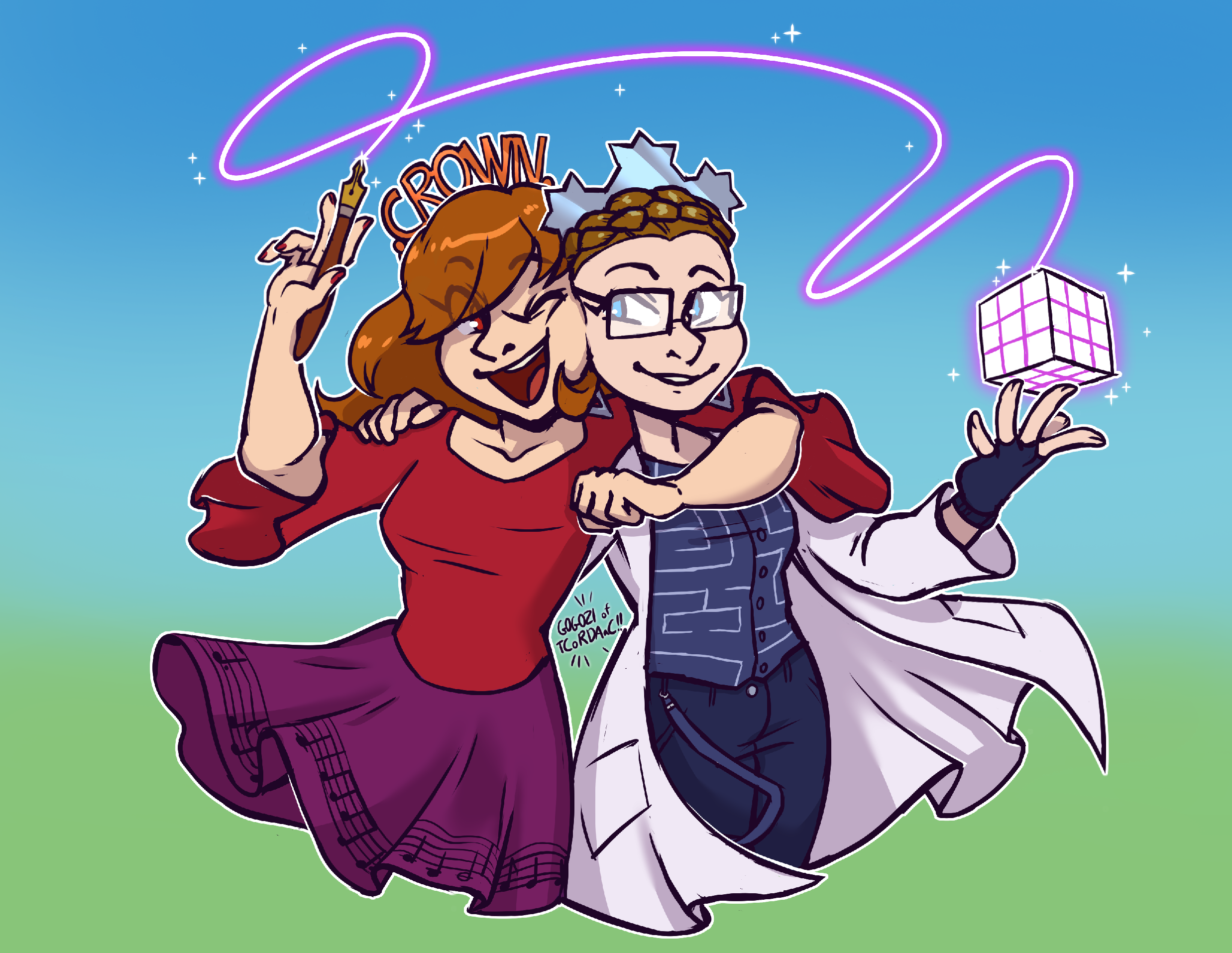
We’ve also collected the fanart from the Extol channel for easy perusal.
 From ㎭ COMPLIMENT FOR PRINCESS RHYME.
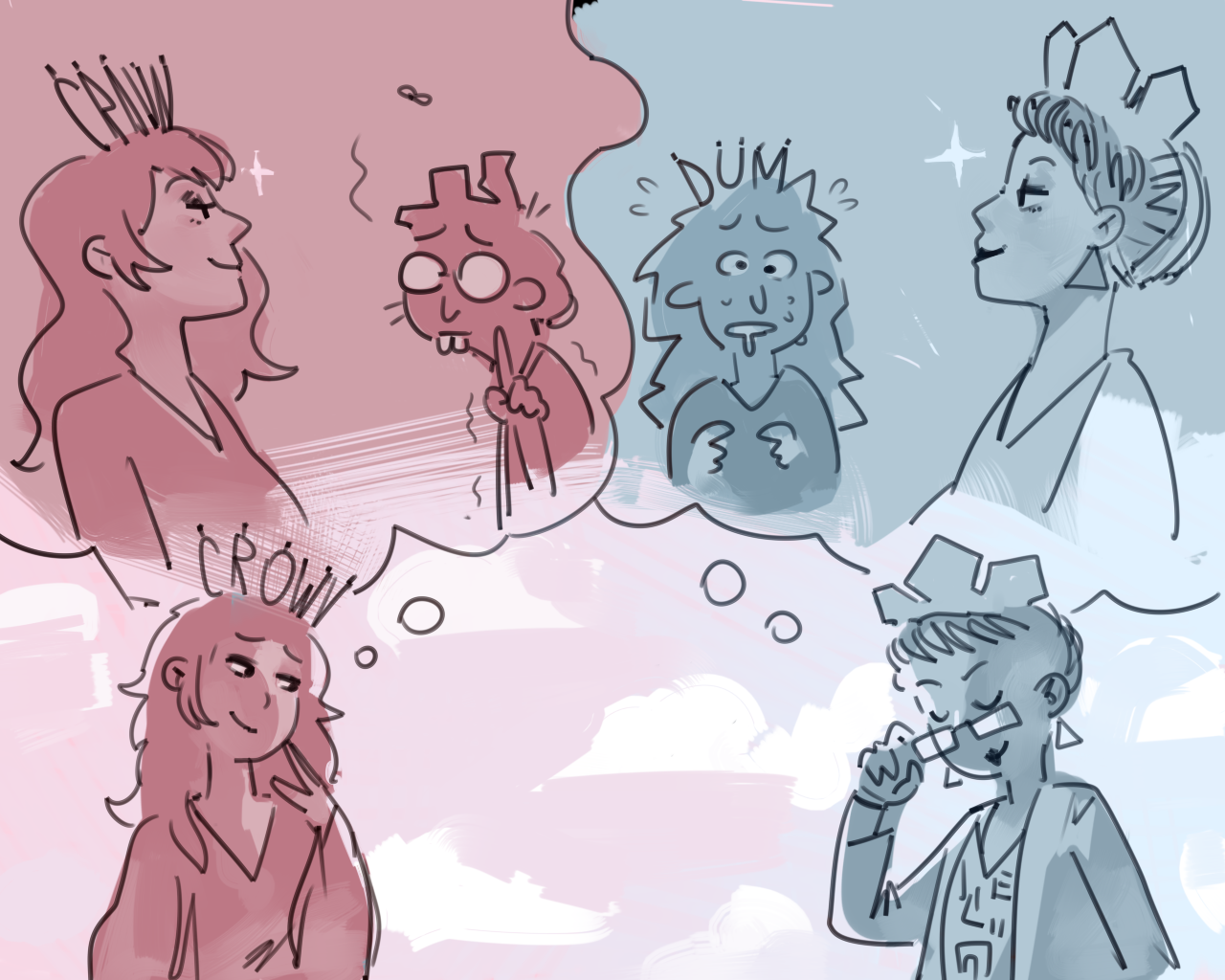 Two pieces of art from The Concept of Rightness Diffracted Around a Corner
 From Lost Librarians
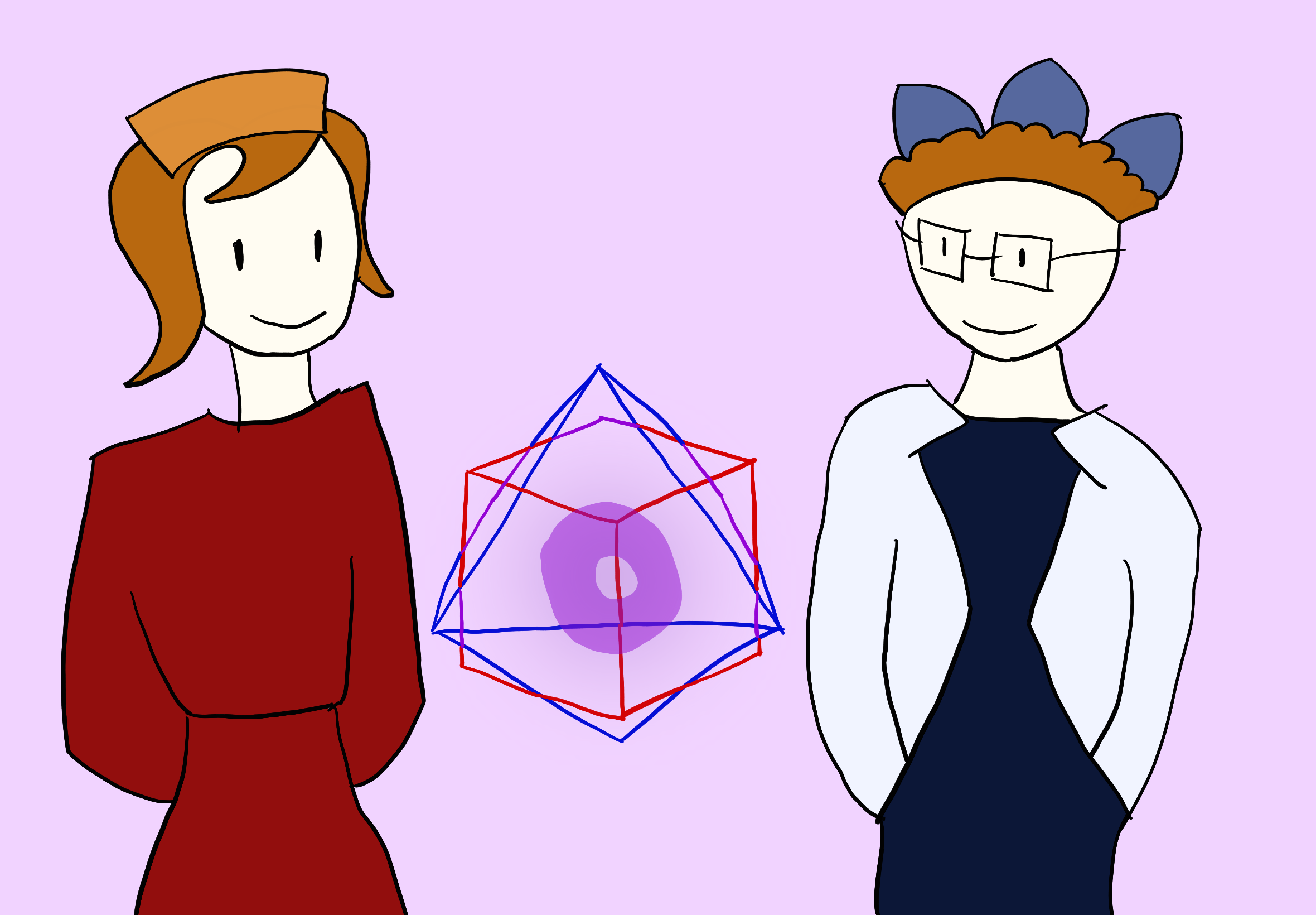 From tock (1)
Internal Art
Some creative works from the team's artists unfortunately didn't make it into the hunt itself.
 Barbie mugshot meme, by NunBird
 Rhyme as a Pokémon trainer, by Grassfur
 Reason as a Pokémon trainer, by Grassfur
 JJBA meme, by Grassfur
Puzzle War Reactions and Submissions
[!! Spoilers for This Is How You Lose the Puzzle War !!]

This Is How You Lose the Puzzle War accounted for a lot of the fun content we received during the hunt. Part of this can be attributed to the infinite answer checkers on each level, but we also got some inspired guesses on the main answer checker.
General Submissions and Hint Requests
- 凑不出-Certainty By Calculation submitted TROLLEYPROBLEM as a clever interpretation of the clue "Sacrifice One".
- Real Tollbooths, Not Phantoms submitted the extremely thematic answer LAVENDERMARRIAGE after receiving the Altar clue.
- Racapyter submitted the ominous IWILLALTERHIM on level 3. In the context of the puzzle as a whole, focusing on "ALTAR" and "ALTER"-ing was quite prescient!
- We were very happy to see BLOODGULCH (The Sunlight Brings Insight) as a guess, given the general thematic inspiration that Red vs Blue provided.
- Riddles Here? Yes Mathemagicians Enjoy had several funny submissions, including JUSTKISSALREADY and (once they’d reached level 6), ICANNOTINGOODCONSCIENCEFINISHTHISPUZZLEANDDOOMTHISYURI.
- puzzles too hard :c also had ethical qualms, submitting WEWILLLETTHELESBIANSWINBYNOTDECODINGTHEIRMESSAGES on part 4. This was followed by a jubilant THELESBIANSWONLETSGOOOOOOO on part 8.
- We sometimes got feedback directly in the answer checker, including THISPUZZLEISTOOLONG (1e308), THISPUZZLEISHOWYOUWINTHEHEARTSOFSOLVERS (decrypt this hunt), and OKAYTHISPUZZLEHASTOOMANYCOMPELLINGYETWRONGANSWERS (Reanimate Spirit: Picking Another Team Name from Zero)
- We have no idea where PANSEXUALPANNSYLVANIA (shaquille-ing the competition) came from
- HOLYFUCKSHESAIDTHELWORD, submitted by when princess reason speaks i sit my joker ass down and listen, needs no explanation


Amusing Answers
In Part 3, Blue asks, "What are you afraid will happen if you reciprocate?" Guesses for Red’s answer included:
- BETRAYAL (freaky rhymes)
- FALLINGINLOVE (freaky rhymes)
- CHECKMATE (An Attempt Was Made)
- SPYFALL (Hee-ho)
- LAPPELDUVIDE (Bird in a Fishtank)
- DOWNBAD (Capybara Collective)
In Part 4, Blue asks, "what do you want us to do next?" Guesses for Red’s answer included:
- KISS (The Sunlight Brings Insight)
- ROBABANK (Slitherlink Implies Slitherzelda Exists, Solve@NUS, and Cryptic Clue #1 Haters)
- FIVEFINGERDISCOUNT (Team Eagle Time)
- GIVEMEFIVE (Team Eagle Time)
- KEEPGOING (ingredience)
- PHISHINGSCAM (Exile)
- FALLHEADOVERHEELS (puzzles too hard :c)
- LESBIANSEX (puzzles too hard :c)
- TAKEDOWNTHEGOVERNMENT (puzzles too hard :c)
In Part 5, Red says "I'm prepared for our double-cross, even knowing what we'll need to do." Guesses for what she was referring to included:
- BETRAYGOD (Casual Goblins)
- KILLCAESAR (Casual Goblins)
- POISONPILL (Casual Goblins)
- GETAROOM (深色墨点)
- DEEPTHROAT (There once was a hunt team named Vehemence / Who had mastered the art of the Bee Defense)
- LIECHEATANDSTEAL (Cryptic Clue #1 Haters)
- ROMANHOLIDAY (Cryptic Clue #1 Haters)
- CHEATONOURWIVES (Cryptic Clue #1 Haters)
- WUHANTIANHEINTERNATIONALAIRPORT (深色墨点)
Two of the Mathemagicians teams seemed particularly divided on this last question:

How Could You!?
By solving part 6, solvers indirectly sent an assassin to kill Red and Blue. This plot point seemed to elicit a lot of strong feelings.


A number of teams took to the answer checker to express their displeasure:
- WAITDONTKILLMYYURIDREAMSWTF (Eggplant Parms)
- IDONTTHINKYOUSHOULDDOTHATMRRHYME (plugh (rhymes with "plugh"))
- CHIEFOFINTELLIGENCEHOWDAREYOU (rhyMETAstic)
- BRUHWHYAREYOUSENDINGASSASSINS, THATSITIMDEFECTING, THISWASSUCHAGOODYURIUNTILYOUMESSEDITUP, YOUARENTEVENGIVINGUSANANSWERCHECKERONPAGESEVEN, BOO (The C@r@d@x Syzygy, who nearly ran out of guesses)
- WHYWOULDYOUMAKEUSDOTHISIREFUSEICANNOTTHISISTOOMUCHDISHONOURUPONNINEGENERATIONSOFYOURANCESTORSMAYYOUFINDTRUELOVEANDHAVEITRIPPEDFROMYOURFINGERSYOUHAVEMADEUSALLMONSTERSANDLETTHATKNOWLEDGEBURDENYOURHEARTUPONANUBISSSCALE (Riddles Here? Yes Mathemagicians Enjoy, giving us the longest answer submitted during the hunt)
- ISTHEASSASSINALSOGETTINGMARRIED (Riddles Here? Yes Mathemagicians Enjoy, a few minutes later)
- SOAREYOUGONNACARRYONTHEASSASSINATION (Ergle Compergle of /r/PicturgleGargle)
A few teams also read a bit too much into the word "swiftly" in the part 7 text:

There’s More!?
Some of our favorite reactions were from teams who wildly underestimated how long the puzzle would be. During the hunt, we collected a lot of screenshots of hint requests that were asking for help on the "last step" in part 5 or 6.


As well as some reactions post-discovery…


Guess Map
The final step of the puzzle asked solvers to determine where Red and Blue were secretly meeting. We got almost 200 unique location submissions, which brought to mind an amusing scenario where the Chiefs of Intelligence (belatedly realizing they’ve been tricked), send operatives to all these far-flung locations. After the hunt, we made a map of all the locations we could place on Earth, just to see what the hypothetical manhunt would look like:
 Click to view the interactive map!
Spreadsheet Names
Solvers came up with some very creative names for their Puzzle War spreadsheets.


Solver Stories
Unencrypted
When I hit the late stages of Puzzle War, I drew a completely different meaning from the protagonists planning to meet at ALTAR. The location had been clued with a mention of sacrifice, I could see the assassin locations made the shape of a pentagram, the assassin was headed there now to kill them, the protagonists needed to do something to win their freedom... so clearly they had planned all this and intended to turn the tables on the assassin in some sort of dark ritual! Alas, it was not to be. Maybe in the gritty reboot?
Joat
Everytime we finished one of the codenames grid in This is How you Lose the Puzzle War, I thought we were done with the puzzle. So yes I went "ANOTHER ONE?!" 7 times. :')
pformal pfroof
we got stuck near the end of puzzle war. some people on our team realized that if you look at the positions of the assassins in the last grid, you find that niulang is a COWHERD who is represented by the GIANT ⭐ ALTAiR, which along with DeNeB, is a part of the summer triangle, which is also an asterism for the ❤️ story of two lovers bound to be apart
acbd
my team met up irl to discuss the puzzles, and then half of us were working on the "This is How You Lose The Puzzle War" together, and im pretty sure we told each other "THIS HAS GOTTA BE THE FINAL STRETCH, LOCK IN" about like 4 separate times before being hit with the devastation that there was yet another part to do
Mathemagicians Embrace Reasoning, Language Introduces Nonsense
"one of my teammates had vibes that red+blue = purple and PURPLE HEART is a war medal which would be thematic. i think it was just too tempting to resist putting it in" (This is the only team to guess PURPLE HEART prior to unlocking level 6).
Cool Stories
We learned during the hunt that RiPS had been completed (and enjoyed!) by a member of SiIvaGunner who contributed to the King for Another Day tournament.
At some point, we received a hint request from a team that had printed and cut out the Statue Park shapes in Six Pack:

Since we had two opposing factions, some of our artists were planning on drawing Rhyme and Reason for Art Fight. That plan was scrapped when Art Fight unexpectedly had three factions this year!
Internal Memes
Identifying which puzzles these refer to is left as an exercise to the reader.


We hope you've enjoyed Paradox Puzzlehunt 2. Bringing this hunt to you has been an unforgettable journey for our team, and we hope that we were able to impart a bit of the fun we had and the lessons we learned. The land of magic opened by The Phantom Tollbooth isn't a place we can stay forever, but we know that a part of it will stay with us when we leave. 💜